News, tips, tricks, products releases, updates....

... from ClearPeople's SharePoint Team, the SharePoint People.
Showing posts with label SharePoint. Show all posts

08 March 2010

InfoPath fix in SharePoint

Here’s a simple, although tedious, fix to a SharePoint InfoPath problem I came across while working at a client site.
I began to notice that when publishing to any of the organisations three servers, if I add a new field to a form, or even modify the schema in the slightest, SharePoint ‘loses’ the content of the cells.
After looking into the problem a bit, it seemed that the cause is that site columns become duplicated during the publishing of an Infopath Form to Forms Services using the InfoPath Publishing Wizard.

The best way to handle this problem is to use Sharepoint Manager 2007 to identify duplicated site and list columns for the Infopath Form list.

The columns being used by a published Infopath form can be identified by opening the Manifest.xsf for the Infopath form and comparing the columnId values to the Id values obtained by using Sharepoint Manager 2007...see, not too bad!


From here, you need to delete the duplicated site columns using the SharePoint site column administration web page.

And also delete the duplicated list columns on the Infopath Form list using Powershell. Just make sure that all the read only columns are set to ‘false’.


For my specific problem, I used the following Powershell.
function Delete_SPFields_From_SPList_Forced([string] $ServerName, [string] $ListName, [string] $FieldGUID){
$spsite = new-object Microsoft.Sharepoint.SPSite($ServerName + $SiteCollectionName);
# Open A Subsite Of The Site Collection. $web = $spsite.RootWeb; $list = $web.Lists[$ListName]; $fieldCollection = $list.Fields; $guid = new-object System.Guid($FieldGUID); $field = $fieldCollection[$guid]; Write-Host “Removing $field $FieldGUID from $Web $ListName” $field.ReadOnlyField = $false; $field.Update(); $fieldCollection.Delete($field.InternalName); $spsite.Dispose();
}
To delete the following fields.
Claim Date 8b4ddc90-5190-4235-bda4-b46ca6c061b1Claim Grand Total 64a160d0-ee6d-4d8f-b383-e5eaf11ecc6fClaim No 83d5c76c-4520-4045-a819-b47bac301e95Claim Status 1db7b23f-e971-447b-b47f-59d9dc6d143cClaimant Name f004b61e-8cea-4fdc-a415-43a42097f751Mdr StaffNo 1f26b5b5-0b71-4ea4-94ee-77ed5ded220c
And all was then good!
Useful references during the trouble-shooting.

http://www.delphi-ts.com/blogs/lozzi/post/2009/06/03/Duplicate-site-columns-in-MOSS-from-InfoPath-Forms.aspx
http://blumenthalit.net/Files/PowerShell%20Scripts/Delete-SPField.ps1
http://pholpar.wordpress.com/category/custom-fields/

Also, if this helped, let us know!

22 May 2009

How to protect SharePoint 2007?

Well, there are a number of options, including using STSADM, backing up 12hive manually and so forth. There are 3rd party tools, and there are PowerShell scripts.

What fewer realise is that there is an alternative from Microsoft themselves called DPM, or Data Protection Manager. We use it in-house and have experienced only a few glitches - but nothing to major. My opinion is that it generally functions well and if you don't have backup and restore tools and procedures in place already for SharePoint then it is well worth a look.

But I am not a backup or operations kinda expert, so I cannot tell you if DPM is "the best out there" or even if it is "enterprise level", but I came across this blog here from Margo on "To the SharePoint" blog which was published a few days ago. They also published this whitepaper: http://technet.microsoft.com/en-us/library/dd252713.aspx

Enjoy...

17 May 2009

SharePoint Server 2010 Preliminary System Requirements

In case you missed it, Microsoft SharePoint Team Blog announced the "SharePoint Server 2010 Preliminary System Requirements" here: http://blogs.msdn.com/sharepoint/archive/2009/05/07/announcing-sharepoint-server-2010-preliminary-system-requirements.aspx

My 10 sec summary:
- 64bit only
- Windows Server 2008 only
- Windows SQL Server 2005 or 2008 only
- Browser support for: standards based browsers (XHTML 1.0 compliant) including Internet Explorer 7, Internet Explorer 8 and Firefox 3.x. running on Windows Operating Systems
- No more IE6 (thank you!!)... it's history! See http://support.microsoft.com/gp/lifepolicy

24 April 2009

SharePoint Server 2010

Yes, it finally became official (April 14th it was), the baby will be called "SharePoint 2010".

MS are dropping "MOSS" as Office is no longer part of the official name for SharePoint.

I like this extract from the Microsoft SharePoint Team blog: "Don’t try to acronym Microsoft SharePoint Server to MSS since MSS is already taken by Microsoft Search Server. Just remember, SharePoint is SharePoint is SharePoint."

So, what I will try to do here, is maintain a list of interesting posts/entries that I or colleagues spot, or add our own comments, as things about SharePoint 2010 starts to become clear.

Next Wave of Microsoft Office Products Will Redefine How People Work
http://www.microsoft.com/presspass/features/2009/Apr09/04-15Office2010.mspx

Microsoft SharePoint Team Blog:
http://blogs.msdn.com/sharepoint/archive/2009/04/14/microsoft-sharepoint-14-is-now-microsoft-sharepoint-2010.aspx (I think this is the most official Microsoft announcement?)

Bink.nu
http://bink.nu/news/microsoft-brands-office-2010-releases-exchange-beta.aspx

CMS Watch having a rant at the naming:
http://www.cmswatch.com/Trends/1572-SharePoint-2010-Brand-Confusion

SharePoint Buzz blog....
http://www.sharepointbuzz.com/archive/tags/Microsoft%20SharePoint%20Server%202010/default.aspx
nice one about expected features of SharePoint 2010:
http://www.sharepointbuzz.com/archive/2008/11/11/upcoming-sharepoint-14-features.aspx

Announcing Service Pack 2 for Office SharePoint Server 2007 and WSS 3.0
http://blogs.msdn.com/sharepoint/archive/2009/04/28/announcing-service-pack-2-for-office-sharepoint-server-2007-and-windows-sharepoint-services-3-0.aspx
While this link to does directly give any clues to "what will be in SharePoint 2010" it does state that SP2 will be required for upgrades to SharePoint 2010, and it includes a number of improvements that appear to be "staging" the new release, including:
"A new preupgradecheck operation is added to stsadm tool. It can be used to scan your server farm to establish whether it is ready for upgrade to SharePoint Products and Technologies "14". It identifies issues that could present obstacles to the upgrade process. It checks for several SharePoint Products and Technologies "14" system requirements, including the presence of Microsoft® Windows Server® 2008 and a 64-bit hardware, and provides feedback and best practice recommendations for your current environment, together with information on how to resolve any issues that the tool discovers."
More to follow... (and let us know of any good SharePoint 2010 resources you may come across).

07 April 2009

Microsoft SharePoint DM Case Study

It is always great when others want to know more about work we have done - somewhat flattering I guess ;-)

In this case the chaps from Microsoft had heard about our SharePoint Document Management project for Linklaters / Kinstellar. Seeing how the end result shows SharePoint's capabilities as a DM for a larger law firm, they have now turned this into a 2-page case study. You can read it here http://www.microsoft.com/casestudies/casestudy.aspx?casestudyid=4000003953 (written and published by Microsoft)

Or you can get a PDF version from here: www.clearpeople.com/ms-casestudy-sharepoint-dm (scroll down to the bottom somewhere I think)

If this topic interests you then you might also want to check out a recent blog entry here: http://thesharepointpeople.blogspot.com/2009/03/real-life-document-management-on.html

Enjoy!

24 March 2009

Real life Document Management on SharePoint

It's interesting how many blogs, articles and whitepapers are out there regarding document management on SharePoint. But there aren't really that many articles touching on real-life experience with implementing this for larger organisations (let me know if you find any good ones).

In my experience, implementing SharePoint for DM comes down to addressing three key areas, and the following is a summary of experience/best-practice that has been implemented in a number of larger organisations - including some very well respected law firms (and we all know that they are demanding when it comes to DM). These key areas are:

1) Structure
2) Extending
3) Surfacing

STRUCTURE
DM on SharePoint, like any other DM solution, requires some planning to ensure that the long-term document volumes are well supported. The solution must therefore be designed at max future capacity (uncommon) or designed to scale to future capacity requirements (more common).

SharePoint has the unfortunate reputation of not being able to cope with volume. This is simply a misconception. My guess is that many have thought that SharePoint out of the box would magically know how to structure millions of documents in a navigable and scalable structure. It doesn't and some work is required for you to get it right. But it's not rocket science.

For a recent client - a large law firm (and off-spring from a global top 5 law firm) - we implemented our best practice and we can comfortably claim that scaling to around 10TB is possible without issues (all things being equal and all sorts of other caveats).

The best practice (shown for a law firm here) is simply:

[web app root site collection]
/clients [managed path]
.../[Client Site Collection]
....../[logical sub site]
............/[matter/case/project document library]
....../[logical sub site]
............/[matter/case/project document library]
.../[Client Site Collection]

The structure above sub-divides the overall structure into neat and manageable containers (Site Collections, Sites and Document Libraries).

Importantly, it breaks up the document volume across Site Collections, which then allows you to limit the size of content databases, by associating Site Collections to different content databases. The actual physical storage limit of a Site Collection / Content database varies depend on who you ask. Typically from 50GB to a few hundred GB (we have tested 400GB successfully) per Content Database is generally accepted.


EXTENDING
There are some gaps in SharePoint that you will want to address... We tend to address most of them with a great SharePoint Add-On (WISDOM DMF Pro) from our excellent partners in Australia, MacroView.

Unique Document Numbering
I.e. a document may have a unique ID in a Document Library, but this same ID will most certainly exist for another document in another Document Library. One of the features that we get with DMF Pro is a central feature to provision such unique IDs on saving a document into a library.

Document Reference
The feature above is enhanced further, by also allowing DM administrators to set their own variables for a document reference. E.g. "[Doc ID] - [Project Number] - [Client Number ] - [Title]" which is saved into the document properties.... Excellent for document footers I tell you ;-)

Provisioning
A DM is rarely a stand-alone app, so extending SharePoint and providing web-services for automated provision of areas (site collections, sites and document libraries). Commonly we see this used by accounting, crm or "Practice Management Systems" during the workflow of creating clients or client projects/matter.

Permissions
It goes without saying that some areas (sensitive matters/projects etc) need tight security and in my experience, providing an efficient way of doing this reduces the risk of this task being "forgotten". We have had good results from providing a simple interface (web service) for automated lock-down of areas. I.e. a workflow, or other can, during the provisioning process, fire off a request to lock down a site or document library to specific AD users or groups.


There are a few more details .... but enough for now... over to surfacing.

SURFACING
It ain't going to be a success if your users don't like using it. I tend to use the term "surfacing" to cover everything that we do to "surface" SharePoint to the desktop. I.e. any desktop client apps, office plug-ins etc. The key is to make it as intuitive as possible for the user to use SharePoint as their DM repository. Here again we use the WISDOM DMF (Pro) Add-on for SharePoint which allows us to give the users a consistent experience across Word, Excel, PowerPoint and Outlook, in addition to Adobe Reader/Acrobat. So all the save to / open from is handled neatly. Searching for documents on SharePoint is available straight from the plug-in. Drag & drop in Outlook for email management and lots more. All out of the box.

Right that's it for now.... I might add a bit more detail to this article. But feel free to comment/ask questions ....

22 March 2009

Those SharePoint alerts are just filling up our inboxes

How often have we heard this complaint from IT Managers with enough to worry about already. SharePoint is a great tool, and alerts are really useful, but the reality is that they get overused and therefore very quickly ignored.


Result: loads of alerts are filling up users' inboxes, and they are either just being left there, or they get deleted by the users without ever getting read.

And hey, how about coming back from vacation and finding your inbox jammed with irrelevant notifications?


We were asked - about 6 month ago - to develop a little "instant message" alerting mechanism for a client. As soon as we heard about it we thought this sounded like a neat little idea. Another client happened to complain that same week about their FD sending global emails with massive attachments. His messages really belonged to a SharePoint announcement list, but they were reluctant to start alerting users even more than they did already via SharePoint.

Two weeks after I was discussing how to use SharePoint for contingency planning, and the topic of notifications came up again. The organisation really wanted to use SharePoint as a primary location for contingency information, and as the primary mechanism to distribute information. Long story short, email is a great mechanism, but not fast enough, and what if email servers are down. So as a primary distribution mechanism, how about something that broadcasts directly to the users from SharePoint.

Right that was it. We just had to get to it, and CorpCast was underway.....

CorpCast was built as a "stand-alone" communication tool, i.e. it does not require Office Communication Server, Exchange or other. Just SharePoint standard edition, and a port to broadcast on.


We released CorpCast about one month ago, and are getting some great feedback at the moment (thanks to everyone who have been providing this feedback).


Let me quickly summarise how CorpCast works:

A SharePoint feature allows Site Owners to configure CorpCast notification alerts on any list. CorpCast can be configured to notify individual users or groups, and can be set to trigger notifications on Add, Update or Delete events on the list.


So, when a new item is added to a list the event is caught by CorpCast, and it passes a message to the "CorpCast Server Service", which in turn broadcasts the notification to all listening CorpCast clients.

On the client a little light weight application is installed to the Windows notification area, and displays the notification with the "toaster effect" on the users desktop. When the user clicks on it, it closes and the user is taken straight into the relevant item on SharePoint.


So, the feedback we have had since is that this is great for:

- contigency planning
- reducing email alerts filling up Outlook
- pulling users into specific areas of SharePoint (i.e. this is a great tool to encourage people to visit a newly published intranet page)
- support / helpdesk lists, to instantly notify the helpdesk team.
- etc


(keep the feedback coming, and tell us how you are using CorpCast)

We have uploaded latest version of CorpCast here: www.clearpeople.com/corpcast
You can download a free - fully functional - 45 day trial.


Also -here is a One Minute Demo... not the most impressive video editing skills (I admit it), but should give you enough to get going on (and I promise I will record/edit something better soon):


Gabriel

18 September 2008

Document Management on SharePoint

The good news is that Microsoft SharePoint can be a very effective document management platform – popular with users, efficient in operation and able to handle very large volumes of documents. But it's not just a matter of deploying Microsoft Office SharePoint Server 2007. Indeed many organisations experience significant frustration with their attempts to use SharePoint for document management. This article looks at the common frustrations and misconceptions and how they can be overcome.

Interest in SharePoint for Document Management
At first glance, the idea of using SharePoint for document management appeals to many organisations. SharePoint 2007 has native document management capability – its document libraries can be used to store all types of files; SharePoint supports Check In / Check Out, Version History and Retention Policies. SharePoint document libraries can store additional classificatory or meta-data related to the files and provide an intuitive means of viewing and working with that meta-data. SharePoint offers Search functionality and of
course SharePoint is web-based, which opens up the prospect of simpler remote access to and sharing of documents and files with key clients and business partners.

News of these document management features in SharePoint is motivating many organisations to look to SharePoint as a way of improving on existing File Shares (e.g. G: or P: drive) for managing their documents and files.

SharePoint is relatively inexpensive; it has other potential applications beyond document management (such as maintaining the intranet and collaborating on project-related data) and SharePoint allows users to continue with the familiar approach of naming files and choosing a location for them as they are saved (which helps to reduce the cost of re-training staff who are accustomed to storing their files on File Shares).
These cost-of-ownership factors are even leading some organisations that have licenced a traditional DM system (such as Hummingbird DM or Interwoven Worksite) to consider whether they should be replacing their traditional Document Management systems with SharePoint.

A Common Mistake – Reproducing the Folder Hierarchy
SharePoint document libraries can contain Folders, and SharePoint 2007 supports a hierarchy of folders in a document library. This leads to a common mistake as organisations switch from their File Shares to SharePoint – they reproduce the folder tree structure that was present on the G: or P: drive with a
folder tree in a single SharePoint document library. Migrating existing documents is easy because SharePoint allows you to cut and paste from Explorer View or when a document library is opened in Internet Explorer.
However this approach of reproducing existing File Share folders with SharePoint folders leads to frustrations down the track with searching and volume handling. The names of folders cannot be used to refine a SharePoint Search. In order to take advantage of SharePoint’s capabilities a preferable approach is to make use of meta-data columns, which are defined at the document library (rather than folder) level. Storing large volumes of documents is best done with a tree of sites, rather than with a tree of folders in a single document library. For these reasons Folders are used sparingly in best practice SharePoint document management environments.


Key Weakness – Capturing Meta-Data for Email Messages
However SharePoint does a poor job in capturing the meta-data related to Outlook email messages. This is a common source of frustration for organizations as they make their first move to SharePoint-based document
management.
Email messages are a vital source of corporate knowledge and typically are stored in personal mailboxes and so not well managed from a corporate perspective. This is why many organisations identify the improved management of email messages as their initial application of SharePoint’s document management capability.

SharePoint 2007 does support ‘email enabled’ document libraries. Outgoing emails can be copied to SharePoint by including the address of the document library in the To, CC or BCC list. However with this approach, meta-data is not prompted for as the email is sent – indeed if any of the meta-data columns are
Required, the newly saved message will be left Checked-Out and so not visible to other users until the Sender or an Administrator edits the properties of the message file using the SharePoint web browser interface.
Organizations with Exchange 2007 can use Managed Folders. Saving an email message to a Managed Folder will trigger Exchange 2007 to send a copy of the message to a document library within the Records Center in a MOSS 2007 environment. However additional meta-data columns in these libraries will not be prompted for as the message is sent. Instead the user will receive an alert at a later time, reminding that meta-data is outstanding for multiple messages. By then the user may well need to open and read the message again to determine what meta-data to enter. This is not popular with users, as it increases the overall effort associated with saving the email message to SharePoint.

Third-Party Add-ons To Address this Weakness
Given the volume and potential importance of email messages it is not surprising that there are a number of after-market add-ons for SharePoint that improve the integration with Outlook and streamline saving of email messages to SharePoint, along with meta-data. These include products from Colligo, Knowledge Lake and MacroView.
WISDOM Message from MacroView runs in Outlook and captures meta-data in real-time as messages are saved to SharePoint. WISDOM Message allows a user to drag and drop to save email messages to favorite locations in
SharePoint. It also features excellent handling of attachments (on both incoming and outgoing messages) and avoids duplicates copies of email messages in SharePoint.

13 August 2008

Overview of SharePoint

We are constantly asked about how SharePoint can be used, so we thought we would provide a quick overview.

SharePoint is an integrated suite of applications that delivers, not just collaboration but also it has the ability to provide document management, content management of intranet, extranet and public websites, business intelligence and more. Investments are therefore limited to one integrated platform instead of several fragmented systems. The free Windows SharePoint Services 3.0 (which contains a subset of the functionality provided in the full SharePoint product) could even be considered when the requirements are limited and focus mainly on internal collaboration.

In ClearPeople’s experience, these are the following ways that companies may benefit from SharePoint:

Intranet
SharePoint provides a single point for employees to access information held on existing disparate systems. SharePoint provides a simple and familiar user experience to post internal news, weekly reports, memos and events. Employees can therefore easily add to the intranet without having to depend on IT staff.

Knowledge portal
SharePoint provides the right technological platform to capture, distribute and share knowledge. It allows entry points into the firm’s knowledge resources such as emails, useful links, colleagues’ profiles, blogs, tasks and documents. Out-of-the-box, SharePoint has many of the features required, but it can also be customised to the firm’s specific requirements. A big advantage is the tight integration with MS Office.

Document Management (DM)
SharePoint is an interesting value proposition since it does not require very specialised knowledge to implement and support. A few of the advanced DM features are not available in SharePoint but add-on components and the ability to customise SharePoint often fills the gaps.

Integration
SharePoint has an open, scalable, services-oriented architecture that provides support for standards like XML and SOAP. In non-technical jargon, this means that it is easier to integrate SharePoint with other applications. In addition, numerous IT solutions either use SharePoint as the document repository or allow for integration with web servers. This makes SharePoint an excellent platform for integrating the firm’s DMS, websites, practice management systems and more.

In summary, SharePoint has the capability to fulfill many requirements, it offers extensibility and provides the IT department with more control over business functionality. Furthermore, it reduces the costs of third party licensing and ongoing maintenance and support fees.

06 July 2008

Using Content Query Web Part as a Table of Contents

The table of contents web part can be useful to display sub-sites and pages in a section. However, there is no option to display the description of these pages, so that visitors to the section can understand what the sites/pages contain. This is where the Content Query Web Part is very useful.

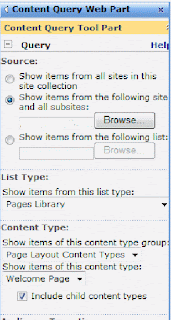
Step 1 - Add the Content Query Web Part to the section where you want to display a table of contents.

Step 2 - Edit the web part and select the relevant site and subsites to be displayed.


Step 3 - you may also select the following settings:
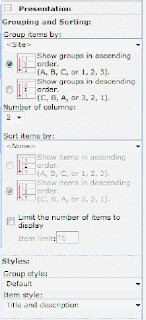

Step 4: Finally, you may also want to populate all default pages with a relevant title and description.

You can play around a little with how this looks but unfortunately there are limited default style options.

Fundi- Katya


01 July 2008

Accessibility Kit for SharePoint (AKS) 1.0

Since accessibility is very much part of what we have been providing our clients, we wanted to share information about the Accessibility Kit for SharePoint (AKS), which is available at http://www.codeplex.com/AKS. The AKS provides templates, master pages, controls, and web parts along with technical technical documentation that enable designers and developers to advance the accessibility of MOSS 2007 and WSS 3.0 based web sites and applications.

Remember this is as Microsoft describes "a set of building blocks rather than an end-to-end solution". Read more about this on:
http://blogs.msdn.com/sharepoint/archive/2007/11/28/announcing-the-accessibility-kit-for-sharepoint-aks-1-0.aspx